
Inside Trace · Technique
The physics of climbing better
Good climbers make hard moves look easy because they waste less force. Here is what Trace measures when you film a climb, and the physics behind each thing it tells you to change.
Climbing coaches say the same few things over and over. Straighten your arms. Get your hips in. Trust your feet. Stop hanging around. They are right, and most of us still don't do it, because from inside a move you can't see what your body is actually doing.
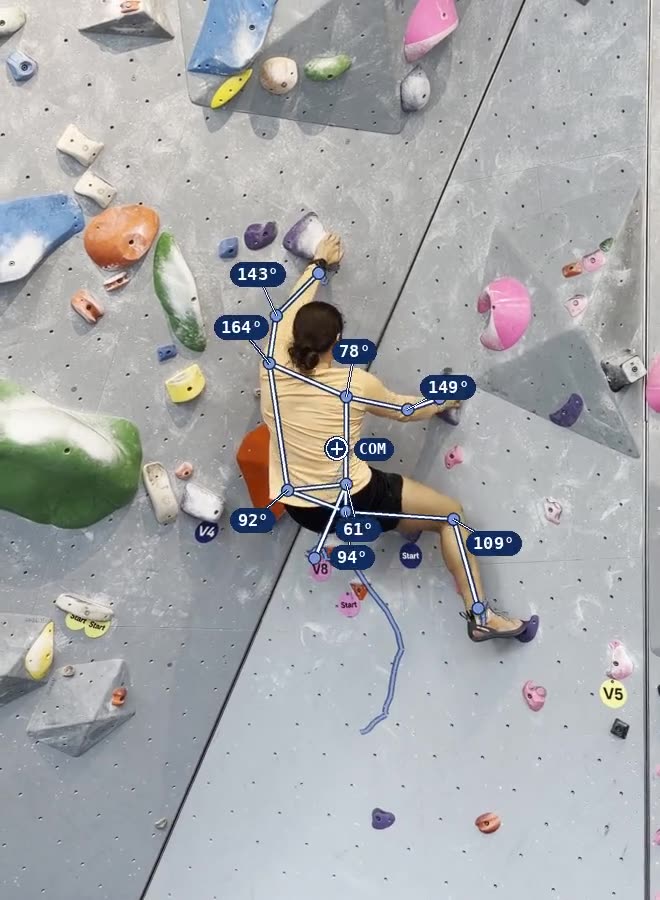
Trace is built to show you. You film a climb on your phone, and Trace turns the video into measurements: where your body was, how it moved, and where it spent effort it didn't need to. Then it tells you the one or two things worth changing, frame by frame, with the fix written out.
None of the advice is new. What's new is that it's measured, on your own climbing, every time. And every piece of it comes back to a handful of physics principles.
What happens when you film a climb
Trace runs Apple's body-pose model on every frame of the clip, right on your phone. It finds 15 points on your body, from your nose and neck down through your shoulders, elbows, wrists, hips, knees and ankles, and joins them into a skeleton. If the gym is busy, it locks onto you and follows you rather than whoever walks past.
From the skeleton it builds three things:
- Your center of mass, the single point your body's weight acts through.
- The angle at every joint, so it knows how bent your arms and legs are at each moment.
- The timing of every move: when each hand and foot leaves, travels and lands.
Everything is measured in torso lengths rather than pixels, so it doesn't matter how far from the wall you stood the phone. Then it compares what it saw against thresholds set from real climbing footage. Anything that crosses one becomes a finding: a frozen frame, the joints involved, and one sentence on what to do instead.
Your center of mass is what climbs
You don't really climb a wall with your hands. You move your center of mass up it, and your hands and feet are how you hold it in place between moves.
Trace finds that point the way biomechanics labs do. It splits your body into segments (head, trunk, upper arms, forearms, thighs, shins) and weights each one by its share of total body mass, using standard figures first measured by Wilfrid Dempster in the 1950s. The trunk carries about half your mass, each thigh about a tenth, each forearm and hand only about 2%. Average those segments by weight and you get your center of mass, frame by frame.
Its path up the wall is the thread that runs through everything else. A clean climb leaves a short, steady line. A struggling one leaves loops, dips and stalls.
1. Keep your weight over your feet
Your legs are far stronger than your fingers, but they can only help if your weight is on them. That comes down to where your center of mass sits relative to your feet.
When your center of mass is directly above a foothold, gravity pushes you straight down onto it. When it drifts out to one side, gravity starts to rotate you around your feet, and the only thing stopping that rotation is your grip. Climbers call the extreme version a barn door: one hand and one foot on, and the whole body swinging open like a hinge.
That twisting effect is torque: your weight multiplied by how far it sits from the pivot. Double the sideways distance and your hands do roughly double the work just to stay on. Weight on your feet also helps the feet themselves. A shoe's grip on a hold comes from friction, and friction grows with how hard the shoe is pressed into the hold. Stand on a foot and it sticks. Hang off your arms and the foot skates.
Trace watches for this during every pause. It measures how far your center of mass sits outside your planted feet, in hip widths, and flags Weight hanging off your arms when you're consistently out past about three-quarters of a hip width. It also flags Hanging outside your contacts when your weight sits beyond everything you're holding for more than a second, and Hips behind the reach when you reach across your body without first moving your hips toward the hold. The fix for all three is the same idea: move your hips first, then the hand.
2. Hang on your skeleton, not your biceps
"Straight arms" is probably the most repeated advice in climbing. The reason is leverage, and it's dramatic.
Your elbow is a hinge. When you hang with a bent arm, your body weight pulls down through your hand, well away from the hinge. Your biceps has to hold the elbow from opening, but it attaches only a few centimeters below the joint, while your hand is around 30 centimeters away. That means the muscle has to pull several times harder than the load it's holding. At a right angle it is working its hardest.
Straighten the arm and your weight hangs in line with the joint. The lever arm around the elbow almost disappears, and the load passes through bone and connective tissue instead of a muscle fighting a lever. Your fingers still hold you, but your biceps gets to rest.
Trace measures your elbow angles in every frame where you're holding still. It looks at the straighter of your two arms, because you only need one straight arm to rest on, and flags Bent arms while static when that arm averages under 135 degrees. It also catches Holding a lock-off, when one arm stays bent and loaded for more than a couple of seconds while the other hand moves. Bend to pull, then let the arm go long again.
3. Catch the hold at the top of the arc
Most moves aren't purely static. You push with your legs, your body rises, slows down and briefly stops before it starts to fall. That instant at the top is the deadpoint.
At the deadpoint your vertical speed is zero, so your fingers don't have to stop any motion. Grab too late and your body is already falling. Now your fingers have to absorb that falling momentum on top of your weight, and the faster you're dropping, the bigger the jolt. Grab too early and you're still being driven upward, so you either over-reach or hit the hold before it's taking any weight and lose the moment.
Trace finds every apex in your center of mass path and times each hand landing against it. If your catches are off by more than about an eighth of a second on average, you'll see Catching outside the deadpoint, along with whether you tend to be early or late. That's a timing problem, not a strength problem, which is good news: timing is fixable in a session.
4. Don't pay for the same height twice
Getting to the top of a boulder costs a fixed amount of work: your mass, times gravity, times the height. You can't avoid that part. What you can avoid is everything on top of it.
Climbers waste energy in a few predictable ways. They lift their body, sag back down, and lift it again, paying for the same few inches twice. They set off toward a hold, realize it's the wrong line, and correct mid-move. And they hang in place reading the route. Hanging does no physical work at all, since nothing moves, but your muscles burn energy the whole time just to keep you there. That's why a long pause on a jug still pumps you out.
Trace splits your climb into individual moves and compares the path your center of mass actually took with the straight line between where each move started and ended. When more than about a quarter of your travel is detour, it flags The long way between moves. When you spend more than a third of the climb paused, it flags Reading the route while hanging on it. These feed into an overall efficiency grade. That grade is a weighted score built from these measurements, not a reading of calories, but it moves in the direction the physics says it should.
5. Move smoothly, not stop-start
There's a reason expert movement looks smooth. In motor-control research, skilled reaching tends to follow the smoothest possible path, the one that minimizes jerk: how quickly your acceleration changes. A jerky move is one where you keep speeding up, braking and speeding up again, and every one of those changes costs effort and control.
Trace calculates the smoothness of each move with a standard jerk measure, then compares it with your own earlier climbs rather than anyone else's. Everyone moves differently, so the useful question is whether you're moving more smoothly than you used to. If you're noticeably choppier than your own normal, you'll see Start-stop movement.
6. Place your feet once
Feet are where friction lives, and friction depends on a shoe being pressed into the hold and staying there. Every time you shuffle a foot after placing it, you give up that contact and have to rebuild it, usually while your hands carry the extra weight.
Trace tracks each foot placement. When a foot lands and then gets re-placed close by a moment later, it counts as a reset. Enough of them across a climb and you'll see Imprecise feet, with the fix: look at the foothold until your shoe is on it, then leave it there. It also notices Reaching before stepping, when you reach with a hand while your feet are still low and your legs aren't helping, and Stepping too high, when a high step costs more than it gains.
From measurements to getting better
Measurements only help if they change what you do next session. Trace closes that loop in three ways.
Your library. Every climb you film is saved with its findings, so you can see a habit fade over weeks. Trace watches which finding comes up most across your recent climbs and treats it as what you're working on. When you hit the target, say your arms 18 degrees straighter or your foot resets cut in half, it moves you on to the next thing.
Route scan. Photograph a wall and Trace reads each route off it by color and measures its shape: how far apart the holds are compared with their size, how wide the route spreads, and whether one move is much bigger than the rest. Then it suggests routes that train what you're working on. Working on bent arms? It points you to big holds close together, where you can practice hanging straight. Working on deadpoints? It finds a route with one long move, near your limit. It also suggests routes just below your hardest send for most findings, so you're practicing the habit rather than surviving the route.
Beta for your body. Two climbers on the same route often need different sequences, and a lot of that comes down to proportions. Trace builds a figure from your height and arm span, and once it has enough of your footage, from limb lengths measured off your own climbs. Then it works out a line up the route that fits your reach, weighing how far each move stretches you, crossovers, matches and whether your hips stay over your feet.
The short version
Climbing better is mostly about using less force to do the same move. Keep your center of mass over your feet so your legs do the work. Hang on straight arms so your biceps rests. Catch at the top of the arc so your fingers never have to stop a fall. Don't lift yourself twice, and don't hang around. Move smoothly, and put each foot down once.
You've probably heard all of this before. Trace shows you exactly where, in your own climbing, it stopped happening, and what to try on the next attempt. And it does all of it on your phone: your footage never leaves the device.
See it on your own climbing
Film one attempt and Trace gives you your center of mass path, your joint angles and the one thing to change, frame by frame.
Try TraceFurther reading: W. T. Dempster, Space Requirements of the Seated Operator (1955), the source of the body-segment mass fractions; T. Flash & N. Hogan, “The coordination of arm movements: an experimentally confirmed mathematical model,” Journal of Neuroscience (1985), on minimum-jerk movement.